Provider-native usage
Claude usage-credit spend, rolling session and weekly limits, Opus usage when reported, reset times, and local numeric history. ChatGPT surfaces show only recognized counters that OpenAI exposes to the page.
Private usage and efficiency tools for Claude and ChatGPT.
COMPANION shows provider-reported usage when trustworthy numbers exist, then adds local tools that help make prompts, replies, and files more efficient. No account. No backend. No quiet upload happening behind the curtain.
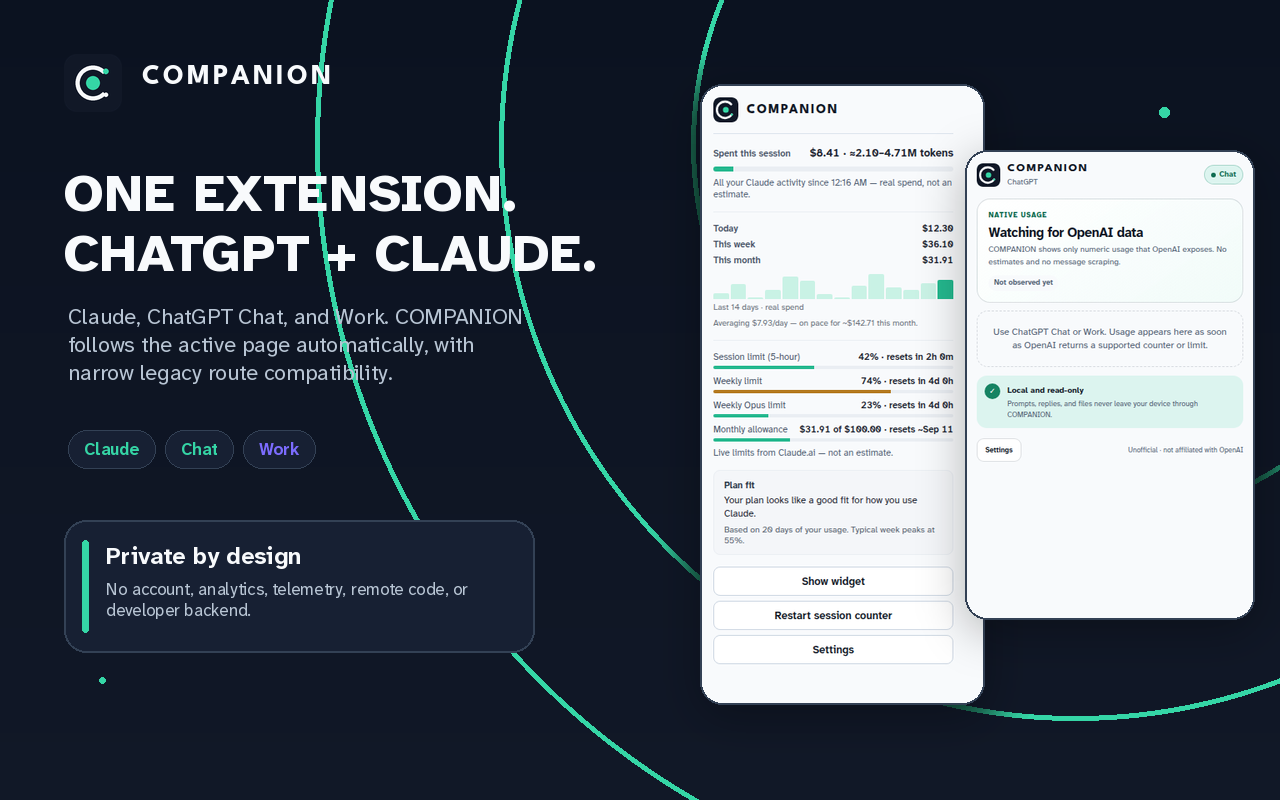
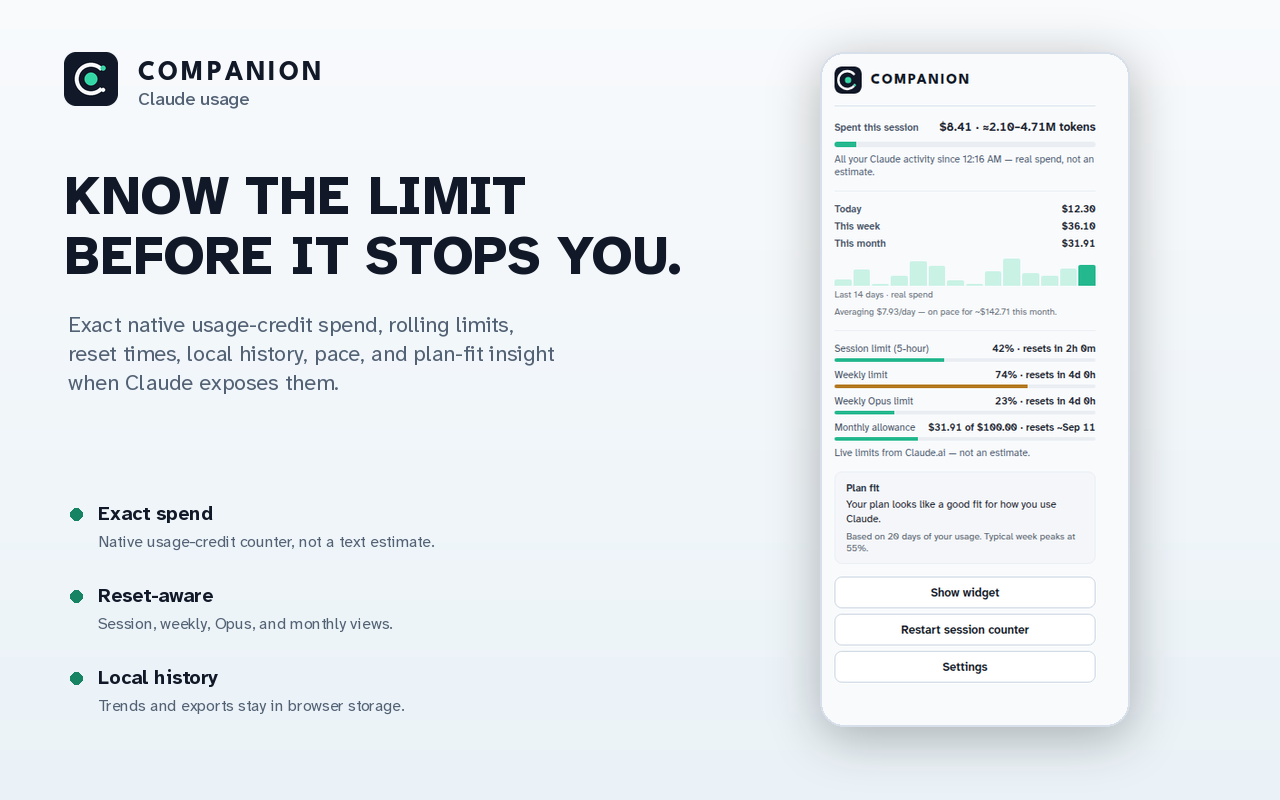
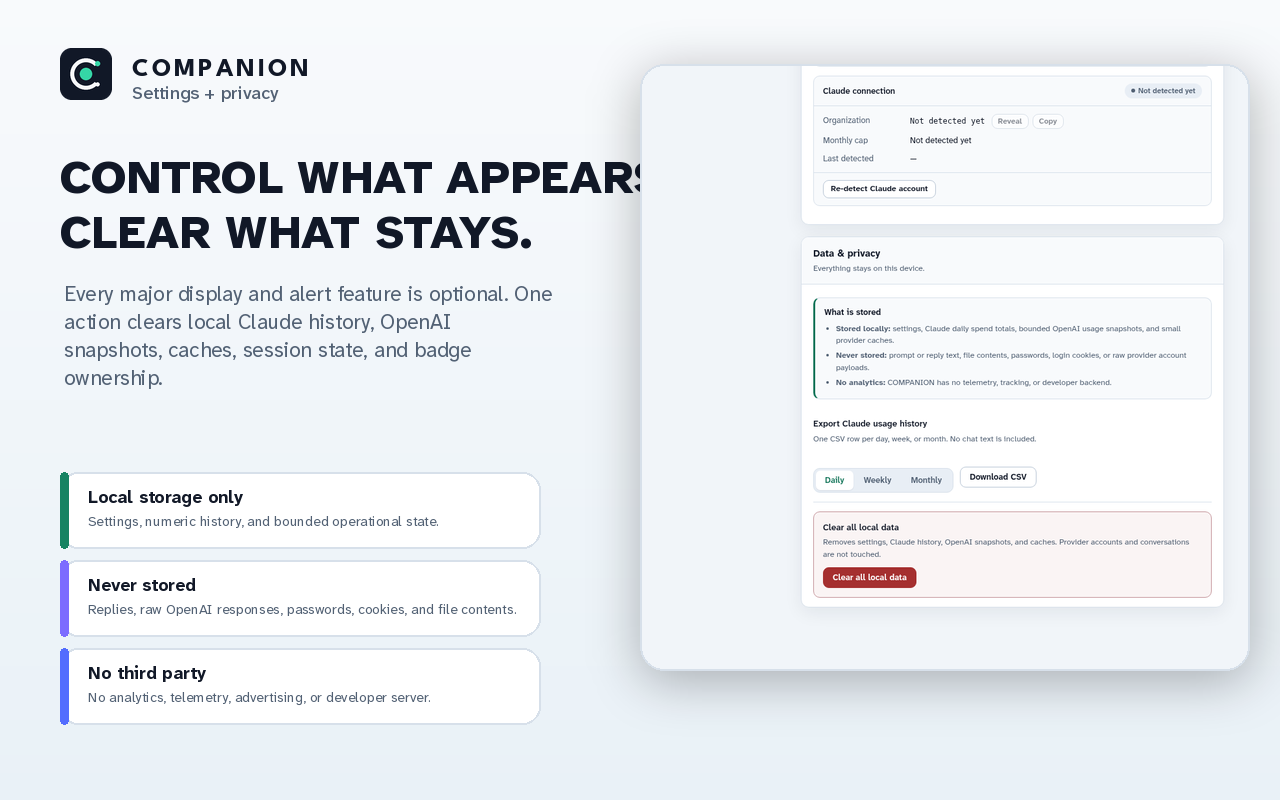
COMPANION renders a provider value when the provider exposes a recognized numeric field. When it does not, COMPANION says so. It does not turn a guess into a polished-looking fact.
The extension as it exists now
COMPANION follows supported Claude and ChatGPT web surfaces, adapts to light and dark themes, and keeps provider boundaries separate under one consistent interface.
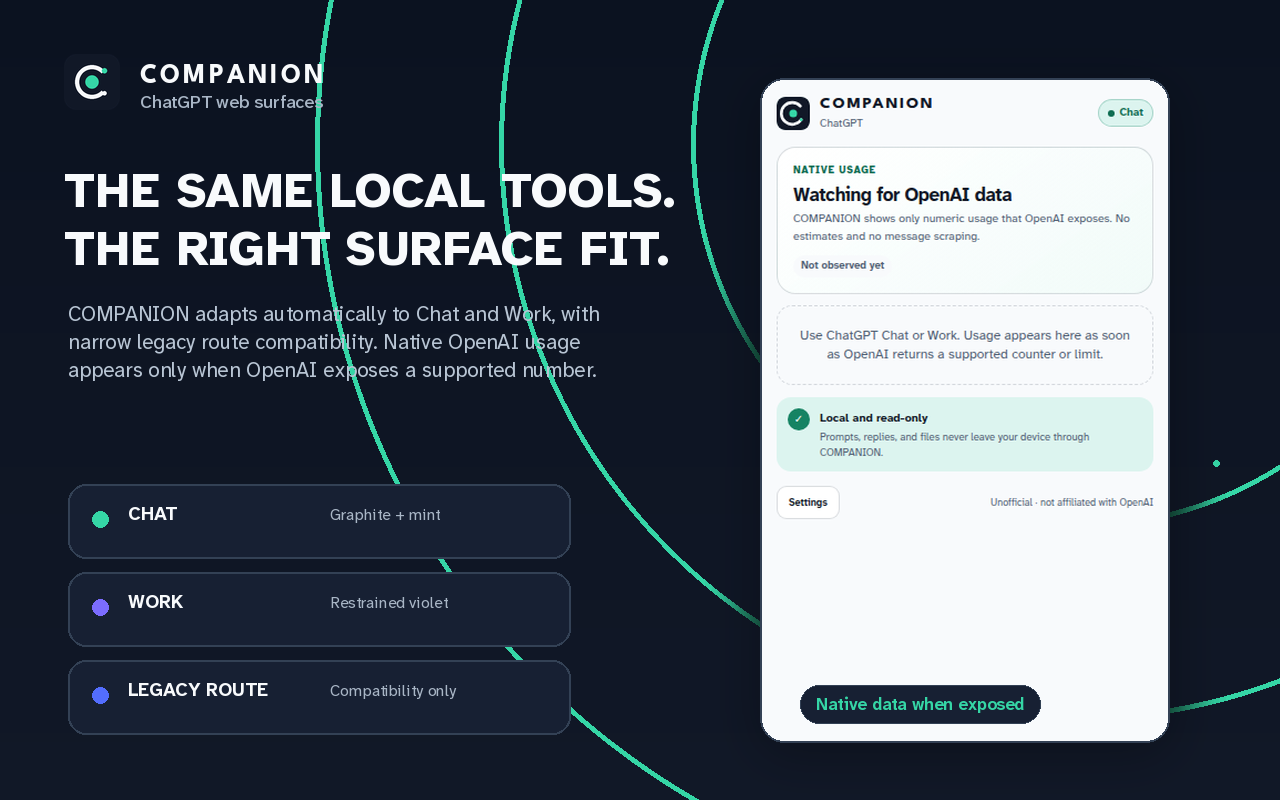
Claude usage-credit spend, rolling session and weekly limits, Opus usage when reported, reset times, and local numeric history. ChatGPT surfaces show only recognized counters that OpenAI exposes to the page.
Optional toolbar badges and desktop notices appear around trustworthy 85% and 95% thresholds, with plain-English pace context instead of constant alarm bells.
Hide the in-page widget, individual Claude metrics, Lifejacket, notifications, or the persistent badge. The extension is configurable without becoming a cockpit.
Lifejacket Mode
Lifejacket is optional and reviewable. It does not silently rewrite or submit your work.
A bundled quantized MobileBERT LLMLingua-style model runs locally through CPU and WebAssembly. Protected code, URLs, quotations, numbers, structured rows, negation, obligations, and bounds are checked before a result is offered.
A separate visible instruction requests brevity while retaining necessary facts, steps, and caveats. It works with prompt compression on or off.
Supported PDF, Office, OpenDocument, RTF, CSV, HTML, Markdown, and text files are parsed locally in a no-network sandbox, then appended to the draft. OCR is not included.
 Lifejacket preview
Compare the shorter version with the original before anything leaves the browser.
Please provide me with a very detailed explanation of Explain how provider-native usage limits differ from token estimates, while making sure that you include necessary caveats.
Compression is lossy. The original remains one click away.
Privacy by architecture
Completely local means there is no COMPANION service waiting to receive your prompts, replies, files, or model inputs.
Read the privacy policyOpen source
COMPANION’s source, security architecture, build process, model provenance, release checks, and issue tracker are public. The project is independent and unofficial, with no affiliation to Anthropic, OpenAI, Microsoft, Hugging Face, or the model author.
Questions worth asking
Yes. There is no COMPANION account, backend, analytics service, remote model download, or developer-side file processing. Provider pages still receive the prompt you explicitly choose to send, because that is how Claude or ChatGPT works.
No. COMPANION shows recognized native numeric fields when available and leaves unsupported values blank. Claude token figures derived from native dollar counters are labeled as ranges rather than exact counts.
Compression is inherently lossy. COMPANION applies conservative safeguards and always presents an editable preview with optimized, original, and cancel choices. Use the original whenever necessary meaning is missing.
No. A native desktop shell is not a Chrome extension host. COMPANION supports Codex-aware web routes and shared agentic usage that OpenAI exposes through ChatGPT web surfaces.
The public launch is planned very soon after review and final smoke testing. Until then, the source and verified release materials remain available on GitHub.
COMPANION is coming to the Chrome Web Store soon.